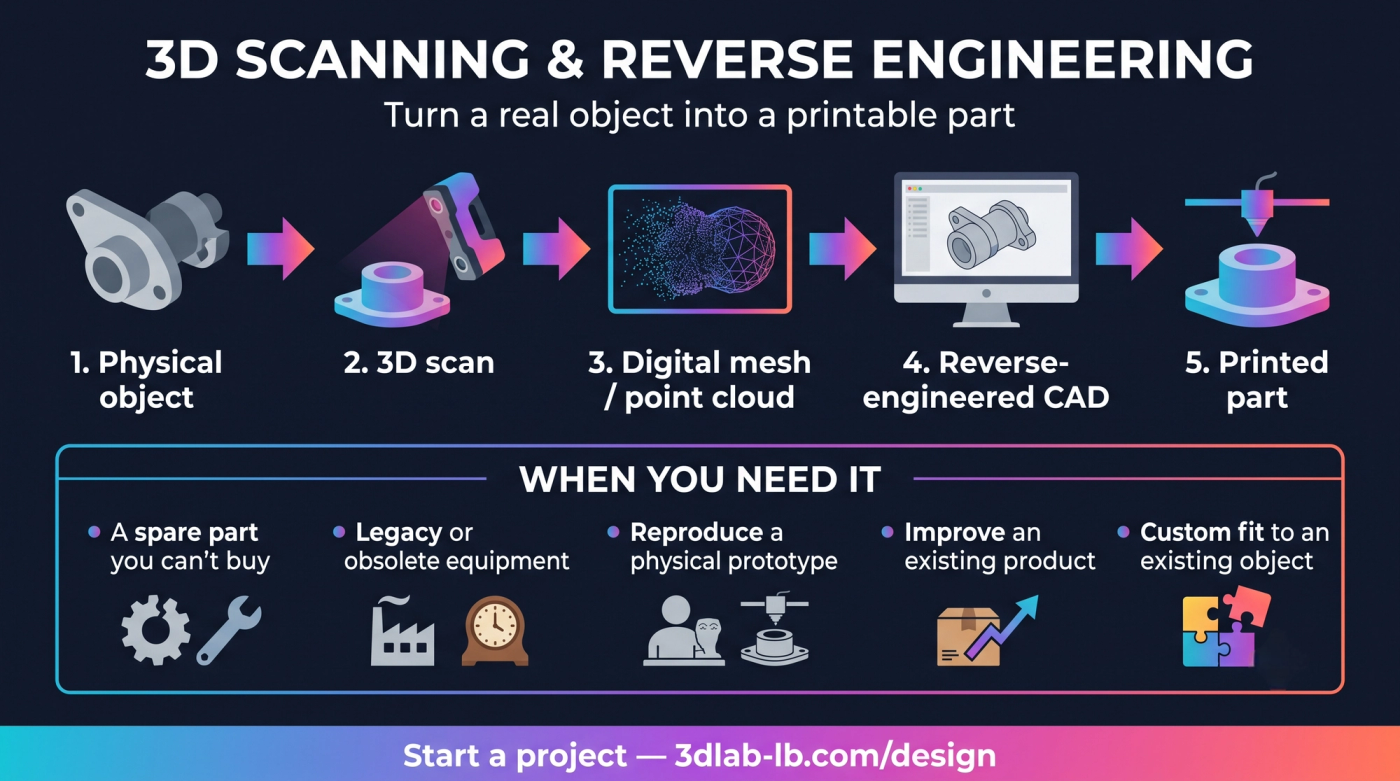
Sometimes you don't have a digital file — you have a thing. A broken part with no replacement available. A component from a machine the manufacturer stopped supporting years ago. A physical prototype you sculpted by hand and now want to reproduce. This is exactly where 3D scanning and reverse engineering come in.
3D scanning: turning a real object into digital data
3D scanning uses a scanner to capture the precise shape of a physical object — measuring its surface as thousands of points and building them into a detailed digital mesh. In minutes, a real-world object becomes data you can view, measure, and work with on a computer.
On its own, a raw scan is great for capturing organic or complex shapes: sculptures, ergonomic grips, an existing part's exact contours. But a scan is a snapshot of the surface, not an editable engineering model — and that's where the second half comes in.
Reverse engineering: from scan to a proper, editable model
Reverse engineering takes that scanned data (or careful measurements of an object) and rebuilds it as a clean, precise CAD model — the kind of file an engineer can modify, dimension, and manufacture from. Instead of a rough surface capture, you get a true digital twin with accurate geometry.
That distinction matters. A scan can reproduce a shape; a reverse-engineered CAD model lets you improve it — fix the flaw that made the original break, adjust a tolerance, or adapt it to fit something new.
When do you actually need this?
Here are the situations where these services solve a real problem:
- A spare part you can't buy. A knob, gear, bracket, or housing has broken and the part is discontinued, back-ordered, or only available abroad at high cost and long lead times. Scan the original (or a matching one), rebuild it, and print a replacement locally in days.
- Legacy or obsolete equipment. Keeping older machinery running when the manufacturer no longer supplies parts — common in factories and workshops across Lebanon.
- Reproducing a physical prototype. You designed something by hand and need an accurate digital version to refine or produce in quantity.
- Improving an existing product. Start from what works, then modify the model to make it stronger, lighter, or better-fitting.
- Custom fit. Matching a new part to the exact contours of an existing object or surface.
Why local matters in Lebanon
For businesses here, the appeal is practical. Importing a single replacement part can mean weeks of waiting, customs, and a price that makes no sense for one component. Scanning and reprinting it locally turns that into a short, predictable job — and once the digital model exists, reprinting more is trivial.
How a project works with 3DLab
You bring us the object (or detailed photos and measurements to start). We scan or model it, reverse-engineer a clean CAD file, and — if you want — print the finished part on our in-house fleet, choosing the material that suits how the part will actually be used. You end up with both a working part and a reusable digital file for next time.
Got an object or a broken part?
Tell us what you're working with. Start a design or scanning project and we'll advise on the best approach, or reach out directly and bring the part in. Already have the model and just need it made? Head straight to the instant quote.
3DLab Engineering — Hamra, Beirut. Describe your part at [email protected] or +961 03 138 224.