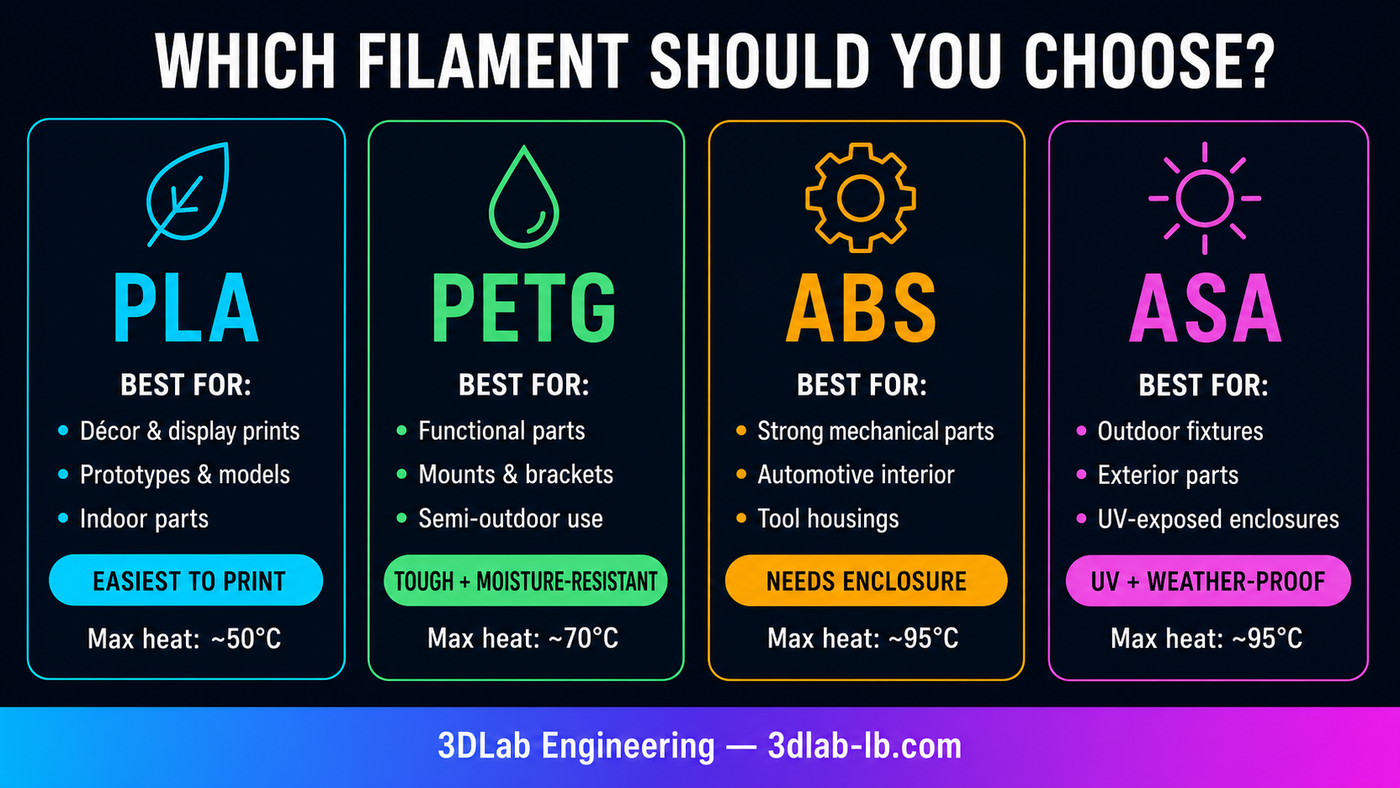
Choosing a filament is the single decision that most affects how your print looks, how strong it is, and how long it lasts. Pick wrong and a part that should have survived years in the sun cracks in a month — or a simple desk model becomes a frustrating, warping mess. The good news: for most jobs, the choice comes down to four materials. Here is how to tell them apart and match each to the right job.
PLA — the easy, everyday default
PLA is the material most prints start with, and for good reason. It prints cleanly, holds fine detail, comes in the widest range of colours and finishes, and doesn't warp. If you're making a display model, a prototype to check fit and size, a figurine, a gift, or anything that lives indoors at room temperature, PLA is almost always the right answer.
Its limits are heat and toughness. Leave a PLA part in a hot car or in direct summer sun in Lebanon and it can soften and deform. It's also more rigid and brittle than the others, so it's not ideal for parts that flex or take repeated stress.
Best for: display pieces, prototypes, toys, décor, indoor parts.
PETG — the practical all-rounder
PETG sits between PLA's ease and ABS's durability. It's noticeably tougher and more impact-resistant than PLA, handles moderate heat better, and resists moisture and many chemicals — which makes it a favourite for functional parts that need to survive real use. It's food-safe-friendly in the right conditions and prints with a slight glossy finish.
The trade-off is that PETG can be a little stringy and is slightly harder to get a perfect surface on than PLA, but on a well-tuned machine that's a non-issue.
Best for: functional brackets, enclosures, mechanical parts, outdoor items with light sun exposure, containers.
ABS — strong and heat-resistant
ABS is the classic engineering plastic — the same material used in LEGO bricks and car interiors. It's strong, impact-resistant, and tolerates real heat, so it's the choice for parts that live in a warm environment or need to be tough. ABS can also be smoothed with acetone vapour for a glossy, injection-moulded look.
Its catch is printability: ABS wants a controlled, enclosed environment or it warps and cracks as it cools, and it releases fumes while printing, so it needs proper ventilation. This is exactly the kind of job where an in-house fleet with the right printers pays off.
Best for: durable functional parts, automotive and mechanical components, anything exposed to heat.
ASA — ABS's UV-proof cousin
ASA has ABS's strength and heat resistance but adds excellent UV and weather resistance — it won't yellow or go brittle in sunlight the way other plastics can. If a part is going to live outdoors, on a rooftop, or anywhere with sustained sun, ASA is the material built for it.
It prints much like ABS, so it shares the same need for a controlled environment.
Best for: outdoor fixtures, signage, weather-exposed enclosures, anything permanently in the sun.
Quick comparison
- Easiest to print & best detail: PLA
- Best balance of strength and ease: PETG
- Strongest with heat resistance: ABS
- Best for the outdoors and UV: ASA
Not sure? You don't have to guess
These four cover the vast majority of jobs, but we also stock specialty filaments — flexible TPU, high-strength PC, and reinforced nylon (PA) — for demanding applications. The right pick depends on where your part lives and what it has to do.
If you're unsure, tell us about the part and we'll recommend the material. Or upload your file to our instant quote — you'll see the price for your chosen material in seconds, sliced from the real weight and print time, not a rough estimate. You can also browse our filaments in the Shop to see everything we carry.
3DLab Engineering — professional 3D printing in Hamra, Beirut. Questions about your project? Reach us at [email protected] or +961 03 138 224.